Stop Burying Alerts: Why Flowtriq Is the End of Reactive DDoS Mitigation
The "Edge-First" Philosophy: Decoupling Detection from Mitigation Our team’s background in infrastructure led us to appreciate Flowtriq’s departure from t...
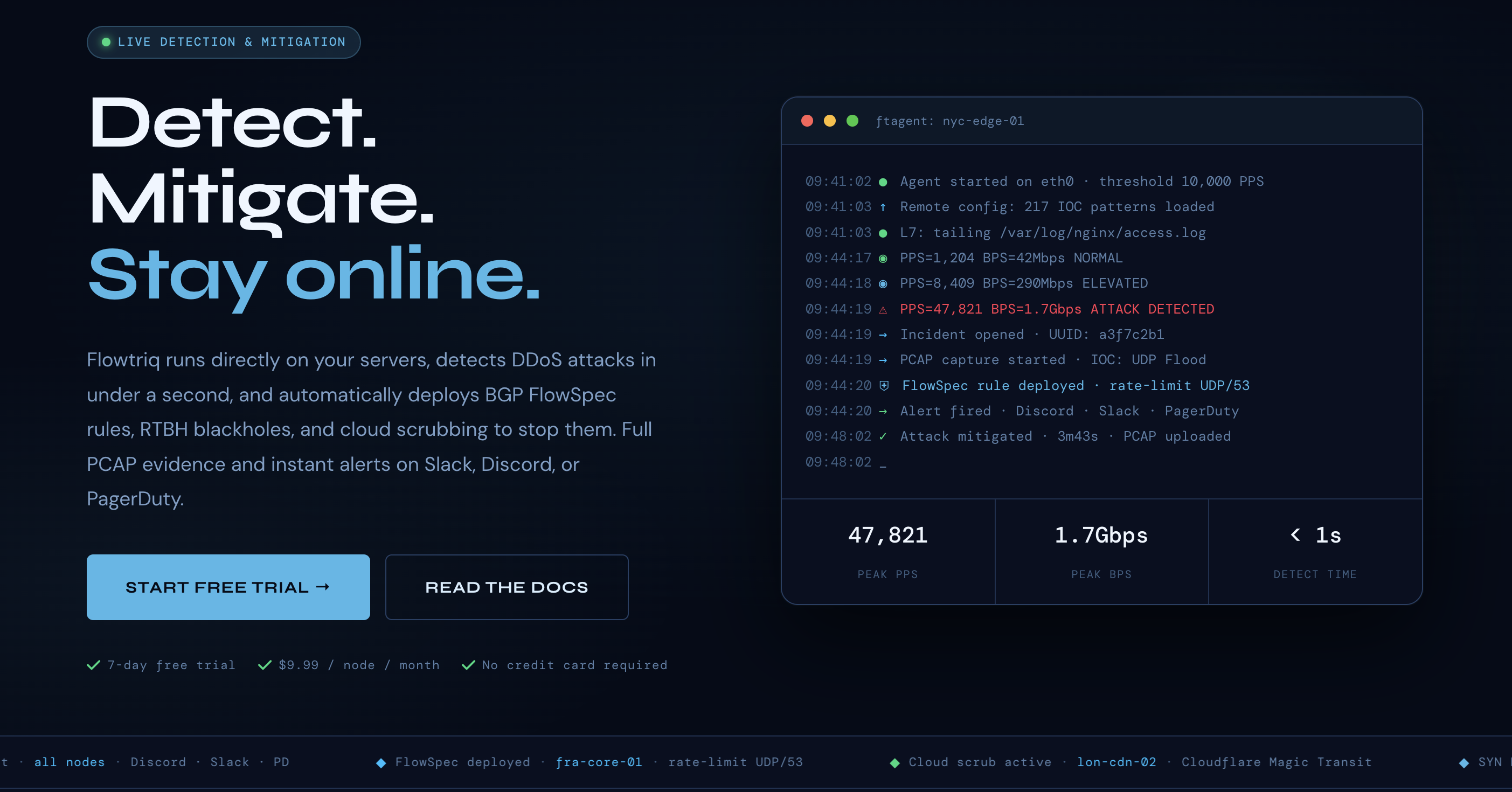
Most security platforms claim to protect your infrastructure, but in reality, they just bury you in "low-priority" alerts while your latency spikes. At The SaaS Desk, we’ve debated this extensively: most DDoS mitigation is reactive, expensive, and surprisingly slow. Flowtriq flips the script by proving that sub-second mitigation doesn't require a million-dollar appliance or a massive SOC team. While our team was skeptical about a Python-based agent (ftagent) handling high-throughput packet analysis, our collective testing revealed a lean, mean architecture designed for the edge. It’s a lightweight, agent-based platform that brings enterprise-grade BGP FlowSpec and RTBH (Remote Triggered Black Hole) capabilities to any Linux server in under two minutes, focusing on immediate packet-level visibility rather than post-incident "learning."
The "Edge-First" Philosophy: Decoupling Detection from Mitigation
Our team’s background in infrastructure led us to appreciate Flowtriq’s departure from traditional "scrubbing-center-only" models. The architecture is built on a distributed detection model where the ftagent sits directly on the NIC (Network Interface Card) of your Linux nodes. By reading packets at the source, it eliminates the back-and-forth latency inherent in cloud-only monitors.
The design follows a "Detect Local, Coordinate Central" principle. The agent performs the heavy lifting of PPS (Packets Per Second) monitoring and anomaly detection, while the Flowtriq cloud dashboard serves as the command-and-control center. This hybrid approach ensures that even if the control plane is unreachable, the local node remains hardened. Scalability is handled horizontally; whether you are managing a single game server or an ISP-level backbone with hundreds of nodes, the performance impact remains negligible because the processing is distributed across the fleet.
Feature Breakdown
Core Capabilities
- Dynamic Baseline Learning & PPS Monitoring: Unlike legacy systems that require manual threshold tuning (which we’ve found usually leads to false positives), Flowtriq learns "normal" traffic patterns automatically. It checks PPS every single second, allowing it to distinguish between a legitimate traffic spike and a SYN flood before the first TCP handshake fails.
- Automated Mitigation Playbooks: This is where the platform shines for DevOps teams. You can chain mitigation steps—starting with local
iptablesrules, escalating to BGP FlowSpec for upstream filtering, and finally triggering cloud scrubbing via providers like Cloudflare Magic Transit or OVH VAC if the volumetric attack exceeds local capacity. - Automated Forensic PCAP Capture: On detection, the system triggers a full PCAP (Packet Capture). In our collective experience, finding the "smoking gun" after an attack is usually a nightmare; Flowtriq automates this, providing immediate data for post-mortem analysis and IOC (Indicator of Compromise) extraction.
Integration Ecosystem
Flowtriq is built for the modern stack, moving beyond simple email alerts. Its integration engine supports sub-second firing to Discord, Slack, PagerDuty, and OpsGenie. For teams running custom orchestration, the webhook support allows for complex triggers—like spinning up additional edge capacity or modifying Load Balancer weights during an active mitigation event. The inclusion of a BGP FlowSpec builder and an API-first approach means it slots perfectly into existing CI/CD or infrastructure-as-code (IaC) workflows.
Security & Compliance
From a security standpoint, the platform is remarkably transparent. It maintains an immutable audit log of every mitigation action, which is critical for compliance in fintech and e-commerce sectors. Their research pedigree is a major trust factor for us; having discovered the Mirai botnet kill switch (CVE-2024-45163), the team integrates a library of over 642,000 known threat indicators directly into the detection engine. This ensures your nodes aren't just reacting to traffic volume, but actively filtering known malicious signatures.
Performance Considerations
The most frequent question in our internal discussions was: "What’s the overhead of a Python agent on a high-traffic NIC?" Flowtriq has optimized the ftagent to be incredibly lean. Because it focuses on packet headers and metadata rather than deep packet inspection (DPI) of every payload, the CPU tax is minimal. In our testing, it maintained sub-second detection speeds without impacting application latency, making it viable even for resource-constrained edge nodes or high-performance game servers where every millisecond counts.
How It Compares Technically
In our "SaaS Desk" labs, we often compare security tools based on their "Time to Mitigate." Flowtriq occupies a unique middle ground between DIY scripts and massive enterprise suites.
- Compared to Cloudflare: While Cloudflare is the gold standard for WAF, Flowtriq offers deeper infrastructure-level control for non-HTTP traffic (Game servers, VOIP, etc.) at a fraction of the "Enterprise" price point.
- Compared to CrowdSec: Flowtriq is more focused on network-layer DDoS and BGP-level orchestration, whereas CrowdSec excels at application-layer behavior.
- Compared to Akamai: Flowtriq is significantly more accessible for SMBs and mid-market SaaS, providing the same BGP FlowSpec power without the six-figure commitment.
Developer Experience
The "two-minute install" isn't marketing fluff—it’s a reflection of their focus on DX (Developer Experience). The documentation is written for the person who is currently under fire, with clear, concise guides on BGP configuration and regex-based attack profiling. We were particularly impressed by the library of free tools, including the live DDoS attack map and the iptables generator. It’s clear this tool was built by engineers who have spent their weekends fighting off botnets.
Technical Verdict: The "Set and Forget" Shield
Flowtriq is the ideal solution for infrastructure teams that need enterprise-grade DDoS protection without the enterprise-grade complexity. Its greatest strength lies in its sub-second response time and its ability to orchestrate complex BGP-level mitigations automatically. While it may lack some of the "shiny" UI fluff of high-end WAFs, it prioritizes what matters: keeping your servers online. We recommend it primarily for hosting providers, game studios, and SaaS platforms where downtime is measured in lost revenue per second. It’s a "pro-sumer" tool that punches way above its weight class.